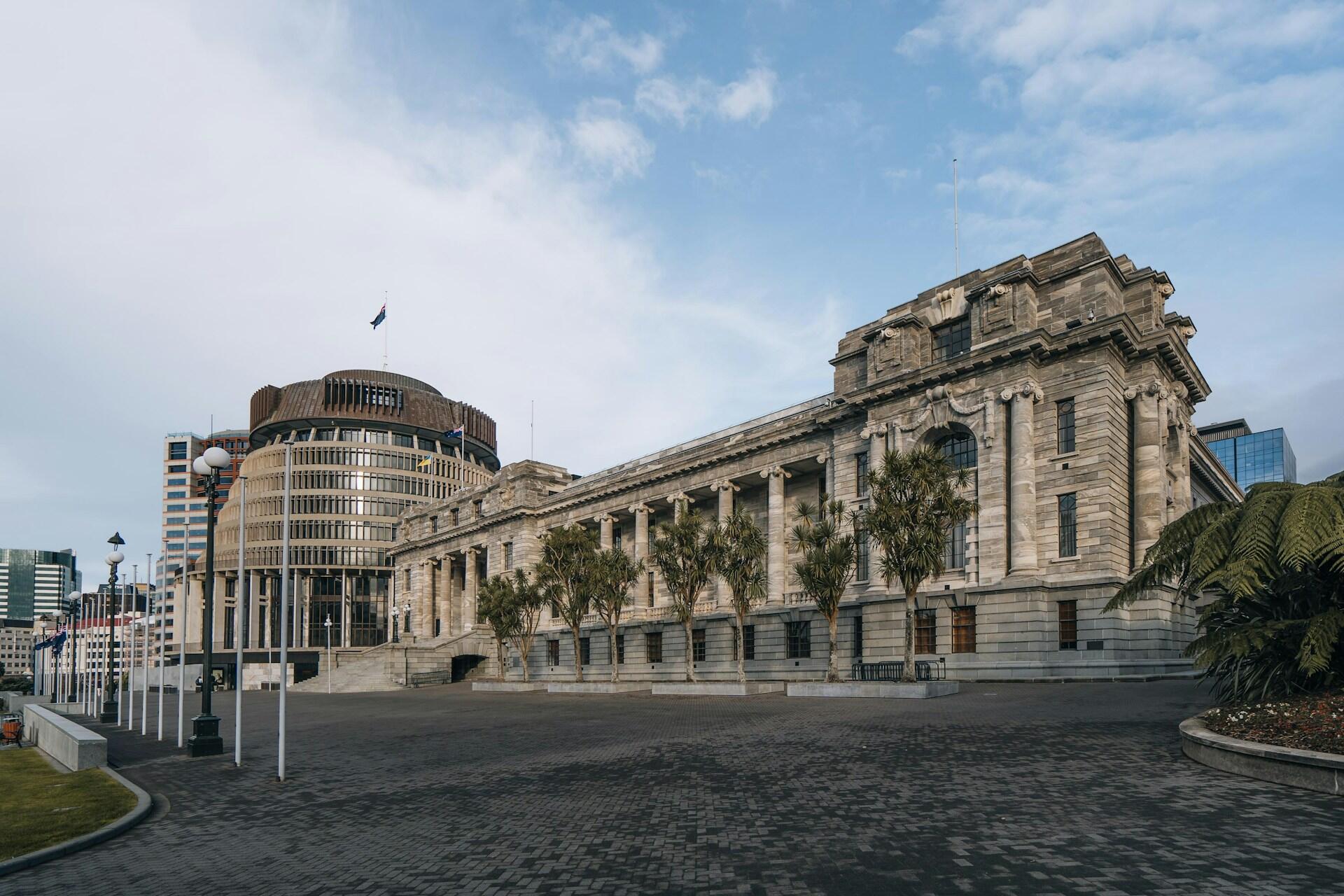

In New Zealand, general elections use the MMP system. This combines local representation and proportional party representation.¹⁰ Every voter gets two votes: an electorate vote, with each serving a different purpose.⁷
Key Takeaways
- MMP stands for Mixed Member Proportional and combines electorate MPs with list MPs.⁷
- Every voter receives a party vote and an electorate vote.⁷
- The party vote largely determines each qualifying party’s total share of parliamentary seats.¹⁰
- A party normally qualifies for proportional seats by receiving 5% of the party vote or winning an electorate.⁷
- New Zealand has 71 electorates for the 2026 General Election, including seven Māori electorates.⁴
- Parliament can grow beyond 120 MPs when an overhang occurs.⁷
- New Zealand first held a general election under MMP in 1996.⁶


What Does MMP Mean?
MMP, or Mixed Member Proportional, is a voting system that combines local representation with proportional party representation.¹⁰ It describes how both MPs are elected and how seats are distributed. Under MMP, electorate results and party-list seats combine to shape Parliament in the New Zealand elections.
Mixed Member
“Mixed member” refers to the two types of MPs who sit in Parliament. Electorate MPs are chosen directly by voters in local electorates, while list MPs enter Parliament through their party’s list.⁷ Both types of MPs have the same rights and responsibilities once elected.
Proportional Representation
“Proportional representation” means that each qualifying party’s total share of seats should broadly reflect its share of the nationwide party vote.¹⁰ List seats compensate for differences arising from electoral results, helping to make the final Parliament more proportional.¹ This compensatory process is a central part of the MMP meaning.
separate votes under New Zealand’s MMP system.⁷
How Does MMP Work in New Zealand?
In New Zealand, MMP gives enrolled voters two choices on a single ballot paper. One vote is for a political party while the other is for a candidate for the local electorate.⁷ Together, these determine who becomes MPs and the overall balance of Parliament.

The Party Vote
The party vote is cast for a registered party. These votes are then combined across New Zealand to calculate the proportional seat allocation.¹⁰ The Electoral Commission applies the Sainte-Laguë formula to determine how the available seats are distributed among qualifying parties.⁷
The party vote is the main factor determining how many seats each qualifying party receives in Parliament.¹⁰ Electorate victories decide which candidates fill some of those seats, while list MPs are used to complete the party’s overall entitlement.⁷ This means the party vote has the greatest influence on the final balance of parties in Parliament.
The Electorate Vote
The electorate vote is for candidates standing in your local electorate. The candidate with the most votes becomes the electorate MP. Even when no candidates receive more than half of the votes cast, they can still become MP.⁷

| Feature | Party Vote | Electorate Vote |
|---|---|---|
| What the voter selects | A political party | A local candidate |
| Main purpose | Determines each qualifying party’s overall share of seats | Elects the MP for the local electorate |
| Where votes are combined | Across New Zealand | Within the individual electorate |
| How the result is decided | Seats are allocated proportionally among qualifying parties | The candidate with the most votes wins |
| Qualification rule | A party normally needs 5% of the party vote or one electorate seat | No minimum percentage is required |
| Can the two votes be split? | Yes | Yes, the candidate may represent a different party |
How List Seats Are Allocated
Once each party's total entitlement has been calculated, the successful electorate candidates are counted first. After that, the places are then filled by candidates from the party list in the order submitted before the election.⁷ There are 71 electorate seats in New Zealand for the 2026 General Election taking place on Saturday, 7 November 2026. This includes 64 general electorates and seven Māori electorates.⁴ In a standard 120-seat Parliament, the rest are filled through list allocation.
A party normally qualifies for proportional representation by receiving at least 5% of the nationwide party vote.¹⁰ It can also qualify by winning at least one electorate, even if its party vote share is below 5%.⁷ A party that meets neither condition is excluded from the proportional allocation of seats.
An overhang occurs when a party wins more electorate seats than its share of the party vote would normally provide.⁷ The party keeps all of the electorate seats it has won, while the proportional entitlements of the other qualifying parties are maintained. Parliament can therefore temporarily contain more than its usual 120 MPs.
Why Did New Zealand Adopt MMP?
Before adopting MMP, New Zealand used First-Past-the-Post. However, under that system, it was more important to win the most electoral seats than to receive the largest nationwide share of votes.⁹ There were concerns about disproportional results and limited representation, which eventually led voters to support reform.
Problems with First Past the Post
The Royal Commission and Referendums
1985
The government established the Royal Commission on the Electoral System.
1986
The Royal Commission recommended replacing First Past the Post with MMP.
1992
Voters supported changing the electoral system, with MMP emerging as the preferred alternative.
1993
A binding referendum asked voters to choose between MMP and First Past the Post.
1996
New Zealand held its first general election under MMP.
2011
A further referendum resulted in voters choosing to retain MMP.⁶
of voters chose MMP over First Past the Post.⁶
How MMP Changed New Zealand Politics

What Are the Advantages and Challenges of MMP?
The overall goal of MMP is to balance local representation while providing proportional results.¹ Like all electoral systems, there are trade-offs. Ultimately, it depends on your own priorities whether you see these as strengths or weaknesses.
Advantages of MMP
Challenges of MMP
Which Other Countries Use MMP?
New Zealand isn't the only country to use MMP. That said, not every country that uses MMP does so in exactly the same way. Here are the other countries using MMP or an MMP-like system.
What Does MMP Mean for New Zealand Voters?
For those voting in New Zealand, MMP gives them two distinct choices at their general election. The party vote means Parliament is more balanced, while the electorate vote gives them a choice to vote for their local MP.⁷ Voters can support the same party with both their votes or choose a local candidate from one party and a different national party.¹⁰
References
- ACE Electoral Knowledge Network. “Advantages and Disadvantages of MMP.” ACE Electoral Knowledge Network, https://aceproject.org/ace-en/topics/es/esd/esd03/esd03a/esd03a01. Accessed 10 July 2026.
- German Bundestag. “Distribution of Seats.” German Bundestag, https://www.bundestag.de/en/parliament/plenary/distributionofseats. Accessed 10 July 2026.
- National Assembly of Lesotho. “The National Assembly of Lesotho.” Parliament of the Kingdom of Lesotho, https://nationalassembly.parliament.ls/. Accessed 10 July 2026.
- New Zealand Electoral Commission. “2026 General Election Media Kit.” Elections NZ, Mar. 2026, https://elections.nz/assets/2026-Media-Kit-/2026-General-Election-media-kit.pdf. Accessed 10 July 2026.
- New Zealand Electoral Commission. “A More Diverse Parliament.” Elections NZ, https://elections.nz/democracy-in-nz/what-is-new-zealands-system-of-government/what-is-mmp/a-more-diverse-parliament. Accessed 10 July 2026.
- New Zealand Electoral Commission. “A Royal Commission and Two Referendums.” Elections NZ, https://elections.nz/democracy-in-nz/what-is-new-zealands-system-of-government/what-is-mmp/a-royal-commission-and-two-referendums. Accessed 10 July 2026.
- New Zealand Electoral Commission. “How Are MPs Elected?” Elections NZ, https://elections.nz/democracy-in-nz/what-is-new-zealands-system-of-government/how-are-mps-elected. Accessed 10 July 2026.
- New Zealand Electoral Commission. “MMP (Mixed Member Proportional).” YouTube, https://www.youtube.com/watch?v=BUvzE-s-430. Accessed 10 July 2026.
- New Zealand Electoral Commission. “The Introduction of MMP.” Elections NZ, https://elections.nz/democracy-in-nz/what-is-new-zealands-system-of-government/what-is-mmp/the-introduction-of-mmp. Accessed 10 July 2026.
- New Zealand Electoral Commission. “What Is MMP?” Elections NZ, https://elections.nz/democracy-in-nz/what-is-new-zealands-system-of-government/what-is-mmp. Accessed 10 July 2026.
- Scottish Parliament. “Additional Member System.” Scottish Parliament, https://www.parliament.scot/get-involved/education/education-resources/parliament-website-resources/interactive-resources/additional-member-system. Accessed 10 July 2026.
Summarise with AI:
Did you like this article? Leave a rating!

 Loading...