

While the warmth of summer may be calling, the academic year is not yet finished as students prepare for their end-of-year exams. Across the county, all NCEA students will sit for the same chemistry exam subject exam at the same time. For level 3 NCEA students this qualification is vital to be able to continue onwards with further study.
When you receive your exam timetable, the first thing you need to do is make sure you have no clashes. Clashes are when you have two exams that are scheduled at the same time. Obviously, you can’t be in two places at once so speak to your dean or teacher as soon as you can and they will arrange for you to be placed into the alternative time slot.
For those sitting the International Baccalaureate or Cambridge exams, there are different requirements and formats. When considering what certification system to choose so you can study abroad such as in the United Kingdom, all three are valid options as the National Certificate of Education Achievement is recognised across many education systems across the globe.
It can all get a bit confusing and many people do not understand how NCEA works. It is based on the New Zealand Curriculum which leans more toward teaching skills rather than explicitly teaching students rote-learned content. For more information read our guide on the chemistry syllabus for NCEA Level 3.

First thing first, you need to have the content knowledge in order to pass your chemistry exam. This includes the use of scientific vocabulary, understanding different chemistry theories and formulas, and more.
Take your time to read over the notes you have taken throughout the year, set up a dedicated study place, and it is better if you space out your study sessions. Instead of doing 12 hours of study in one week, you do three hours of study spread across the week for over four weeks. Short, sharp, and consistent is your key to success





Breaking Down the Question
Once the revision is done, time to tackle the questions. When looking at the format of NCEA exams, the questions become progressively more challenging. The first few questions are achieved, which means the response is straightforward. As you progress through the exam, the questions become more open and can build upon the previous answer. All questions should be attempted as you can be awarded achieved, merit or excellence within the same question depending on your response.
In order to break down the questions, use a highlighter and highlight the keywords. Within the chemistry exam, there are three questions but there are sub-questions within them. The design of these questions is that they follow on from the previous one before. They ask for more detail and enable students to demonstrate the level of understanding they have for each of the exam topics; equilibrium principles in aqueous systems, the properties of organic compounds and thermochemical principles and the properties of particles and substances.
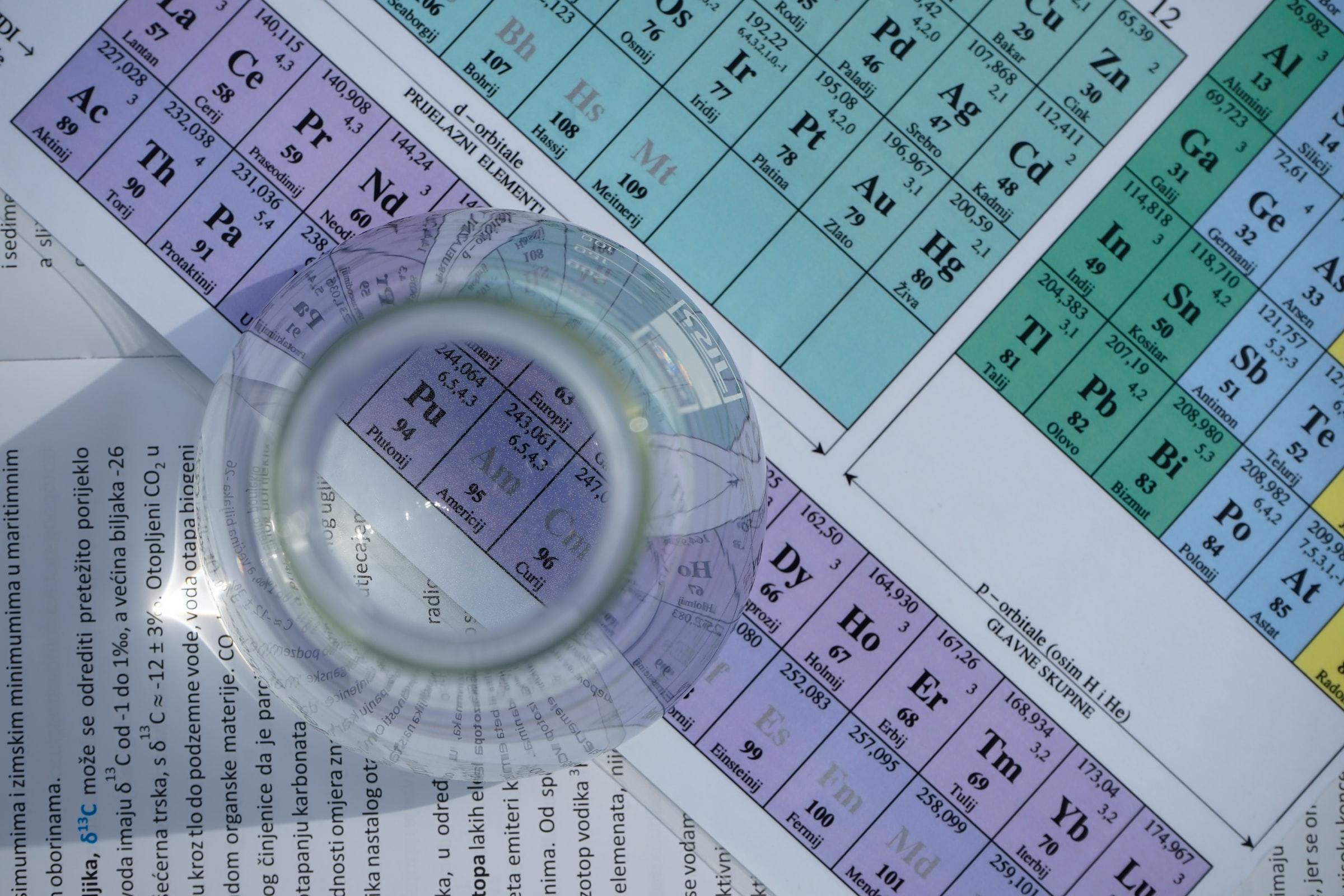
Here are two questions that come from the 2021 NCEA Level 3 chemistry exam.
Question 2 (a): Explain the difference in the atomic radii of calcium and selenium.
Element : Atomic radius / pm
Calcium, Ca : 197
Selenium, Se : 116
When breaking down the question we first look for the action, and what it is you need to do. For question 1 our first keyword is explain, but there are other possibilities such as being asked to calculate. The next step is to look for the boundaries or specifications within the question, which is where the next keyword comes in, difference.
So then you look for what it is you need to explain the difference of, but what in particular? It is very straightforward for this question, I need to explain the difference between calcium and selenium atomic radii. However, not all questions are as simple. Take a look at the following question.
Question 2 (b): Justify, with reference to the factors affecting periodic trends, why fluorine is the most electronegative element in Group 17.
It is more complicated. Here you have to justify your response as well as include the additional criteria. This is where planning is very important as your answer has to follow a logical flow. Justify means to prove/show you are right/reasonable/true. This means for this question you need to use evidence to support your explanation.
If you re-read the question again there is also an added detail, you have to reference factors affecting the periodic table. By failing to do so you can’t be awarded full marks. Focusing on the keywords, especially with long questions, can help you stick to the point and clarify what you need to do.

Revising for your NCEA Level 3 Chemistry Exam
Breaking down questions can also help identify where there are gaps in your knowledge. Our guide on past papers can help you utilise past exam papers as revision tools. In general, the exact topics of the exam the year before will not be repeated but it doesn’t mean they are of no use.
If you have read question 2 and realised ah, I don’t really remember what I learnt on factors affecting periodic tables. That is good, it means you have found a gap that you can work on filling before the exam. Does it mean it will be a question for the following year's exams? No, it doesn’t, but it will increase your general foundations in chemistry which is important if you wish to carry on studying the subject at university.
Tackling Achieved Level Questions
Achieved often is viewed as a bad result when really it means you are working at the expected level for your year or NCEA level, nothing more and nothing less. Within chemistry, achieved questions are built around common skills such as being able to identify, describe, use the correct vocabulary, correct symbols, correct conventions and can solve some calculations.
Often the question will require you to use a mixture of the skills listed above. These questions tend to be easy to follow but you need to demonstrate an understanding of your knowledge. This can mean if you did a calculation, you used the correct formula but you miscalculated a number so if your answer is wrong, you could still be given marks. This is because you demonstrated that you understood what you needed to do but just made an error with the counting.
Tackling Merit Level Chemistry Questions
Merit is given when you are working above the expected level. In order to gain Merit, you need to demonstrate an in-depth understanding of the subject. This includes doing everything you need for achieved as well as being able to explain properties in correlation to the question. The explanation can be done by making connections and explaining different theories, concepts, principles and equations.
These questions tend to be less straightforward than achieved as you need to show not only that you know a range of chemistry conventions but that you can explain them as well. It is the difference between knowing how to solve an equation and being able to explain why you need to use a certain formula.

Tackling Excellence-Level Chemistry Questions
For those looking to flex their chemistry muscles, in order to gain excellence you did to do all of those above and more. You are asked to demonstrate a comprehensive understanding of the subject. This can involve justifying, comparing and contrasting, analysing, relating, evaluating and elaborating. The organisation within your writing is important as you want to be as clear as you can to the marker.
Another section that differs from merit is that there is consistent use of chemistry symbols, conventions, and vocabulary throughout your answers. Your English skills come into play as you need to articulate your points in a logical manner that also respects the language criteria of chemistry. When answering excellence questions you want to show off your skills so if you can, incorporate other ideas or theories that relate to the question. You can also use them to provide contrasts.
Where to get more support
It is crucial that you revise before your exams. Have a read through our Chemistry study guide for a few tips to set you off in the right direction. Finding the right way for you to revise can be difficult. Superprof can help you find the right tutor for your needs at a click of a button. With the option of finding tutors in your area or online, you get the best of both worlds. Prices, times, and schedules are all displayed so all you need to do is compare your options. Check out Superprof today.
Summarise with AI:
Did you like this article? Leave a rating!

 Loading...