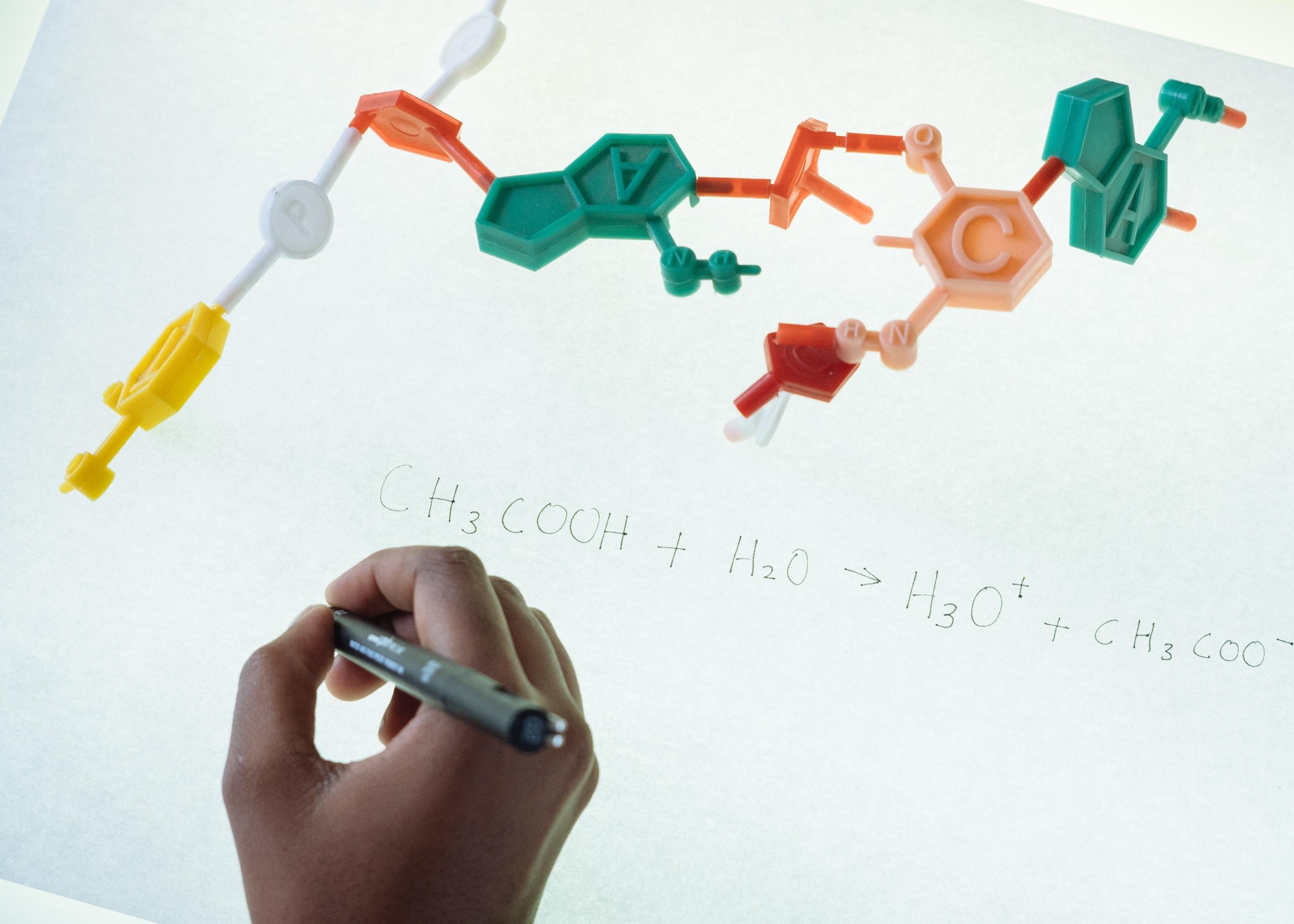

As thousands of students regain some sense of normality in their schooling? the effects of COVID cannot be understated. For some, this will be their first normal year of NCEA and with that comes the challenges of adapting to the way NCEA works.
Our guide on the Level 3 Chemistry syllabus helps to inform students of the connection between NCEA and the New Zealand Curriculum. Internal and external assessments are not the end goal, they are the check-in to see how your learning is going.
Chemistry is a difficult subject, there is no getting around it but it doesn’t need to be hard. Through the organisation, preparation and revision students can succeed. The trick is to understand how to prepare, organise and revise. Spending hours pouring through large paperback textbooks ain’t it.
So what is?





Setting up for success in Chemistry
The way that chemistry is taught in school is that you study topics throughout the year, these topics will align naturally to both internal and external standards. You will build upon the skills you learned the following year, so if Level 2 chemistry was difficult for you, take your time over the year to revise your notes and build mindmaps or diagrams to help you reconnect with the learning you have already done.
Flow charts can really help as at Level 3 you are facing problems that are more complex. These questions require you to become a detective to figure out the best approach to solving them. When you make flow charts you create a visual aid and you can see what decisions you can make at certain points to find the best way to solve the problem.

In theory, revision notes are better to do at the end of each term. You can revise what you have learnt over the course of the year and it also means you will have less work to do at the end. While this is preparation for your exams, you can also use information you have learned from the investigations you have done.
The information you learn throughout the year is just as important as the achievement assessments you do at the end-of-year exams. The key difference is time. Internal assessments need time to be done properly while externals are based on information recall and solving problems rather than investigating them.
Internal Assessments Study Guide
With internal assessments you have time, these are usually done in class or over a specified duration of time like a week. Often they are geared towards investigations or research. These assessments are about you demonstrating your understanding of the process as well as your content knowledge, knowing how to do something is one thing and actually doing it is another.
When you are carrying out an investigation, the process is just as important as your results. In the domain of science, if your results can not be replicated by others then they cannot be considered conclusive. That is why it is important to note your steps in detail so someone could follow them and achieve the same results.
It is also important to make sure you are using the correct vocabulary and symbols. If you consistently go over chemistry terms and symbols throughout the year, it will be easier for you to remember them during your exams. Memory is like a muscle, you have to keep using it or it loses its strength.
The clarity in your writing is also important. It should progress in a logical order and be easy for the reader to follow. Once you get into the habit of using a writing structure, it becomes a lot easier to control your ideas.
External Assessment Study Guide
When it comes to externals it is about being able to recall information under a bit of pressure. The idea is that exams demonstrate what you know and how well you know it without referencing other material. Because of the pressure you are under, the assessments are more heavily weighted credit-wise.
All externals are five credits, and there is a bit more leniency in meeting the criteria than in internal assessments. If you have been spending a bit of time preparing throughout the year you will have great resources to work with in regards to revision material. Our guide on how to use past exam papers is another great resource.

For chemistry, it is really important to get a solid hold of the formulas and theories across the different exam topics. Cue cards, flashcards, and flowcharts are proven tools to help with memory attention. It is best if you create them yourself as we retain more when we write them.
The brighter the better! Use colours that capture your eye, especially for keywords. We remember things in more detail if they stand out from the usual. Your notes should be bullet points and for those who find reading and writing less than ideal, turning keywords or theories into songs really help (look how successful the ABCs are for getting us to remember the letters in the alphabet).
Another crucial element is time, you need to organise your time so you can optimise your study sessions. The optimal duration is three to four hours of study on a subject over the course of five to six weeks. These study sessions ideally are less than an hour but more than 30 minutes.
This is because you want to be fully concentrating on what you are revising. No interruptions or getting sidetracked. Unfortunately, most of us can't concentrate on one thing for a long period of time so it is about finding what duration works best for you. Break up your revision by practising chemistry problems, our guide on tackling NCEA Level 3 questions can help.
Better Late than Never
Cramming is the less effective method in revision but it is way better than nothing. It is always better to hand in 10% of an assignment than nothing because even within the 10% you can still learn. Often the focus shifts from learning to passing but that is not the point.
Even if you give yourself a couple of days it is never too late to try. You have to take a focused approach and really hone in on the basics of your course outline from how to draw isotopes correctly to knowing what acid and alkaline are or are not water-soluble. Bullet points are your best friend and make sure you give yourself time to process the information you are trying to remember.
NCEA Level 3 Chemistry Exemplars
Exemplars are great resources to give you an idea of what a Not Achieved, Achieved, Merit and Excellence external assessment looks like. They are the work of previous NCEA Level 3 Chemistry students that have been chosen to be a representative of what examiners are looking for.
In recent years, NZQA has changed their policy and has been only adding new exemplars when there is a change in the standard, before they use to add new exemplars every year. Even with this change, exemplars are still a great resource as it gives you an idea of what different results look like.
In terms of study, they are to be used to understand the best way to lay out your response. There are absolutely zero benefits in copying the responses because you will never get the same question. You use them to see how they write out their formulae and written responses.
Structure in your writing is necessary for those who want to gain merit and excellence. What is even better about exemplars is they come with the notes written by the examiners. They explain why that mark was given and what more they could do to improve their response.
Spend a couple of minutes reading through the examiner's response then re-read the exemplar. Try to identify the strengths and weaknesses in the students' work so you can learn from it too. Remember copying the answers is a terrible idea as you will not pass your exam and plagiarism has severe consequences.
Where to get help
If you are after a bit more guidance in Chemistry or a study plan that suits your needs, a tutor could be just what you are looking for. Tutors help you revise, learn, improve, understand better and practice a range of different subjects and topics. Whether it be for a short or long-term duration, Superprof has the right tutor for you.
Summarise with AI:
Did you like this article? Leave a rating!

 Loading...